Tax Code Explained: What 1257L Means for Your Pay in 2026/27
Your tax code explained for 2026/27: how to read 1257L, what BR, 0T, D0 and K codes do to your pay, why emergency codes appear, and how to fix a wrong code with HMRC.
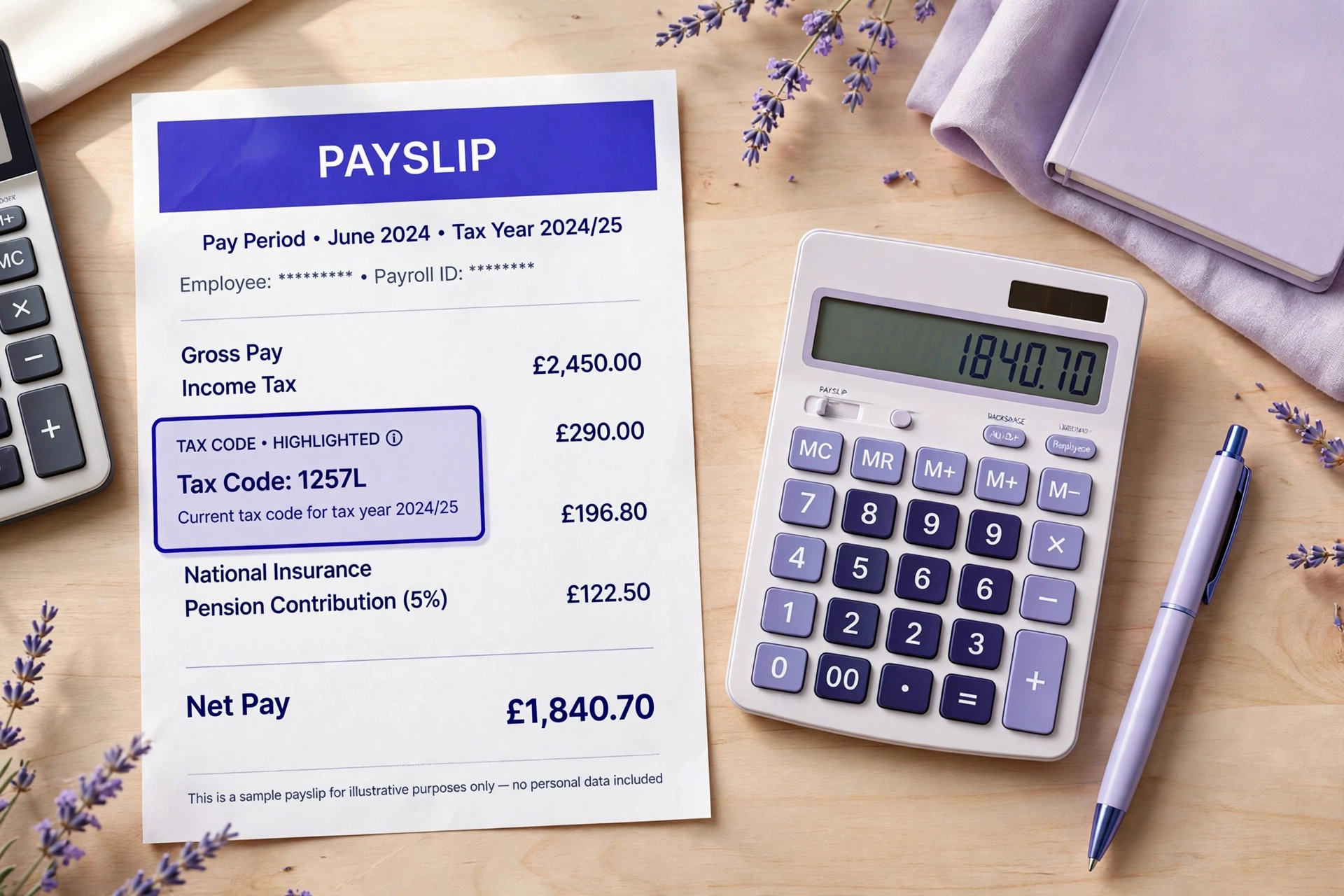
Your tax code explained in one line: the code on your payslip tells your employer how much of your pay you receive tax free before income tax starts. In 2026/27 most employees in the UK sit on code 1257L, which gives you the standard personal allowance of £12,570 a year. If your code is wrong, you pay too much tax or too little, and HMRC collects the difference later. This guide decodes every common UK tax code, shows what each one does to your pay, and explains how to fix a code that looks wrong.
Key takeaways
- The numbers in your tax code, multiplied by 10, equal your annual tax free amount. Code 1257L means £12,570 tax free.
- The letter shows which allowances and rules apply. L is the standard personal allowance, BR taxes everything at 20 percent, and 0T gives you no allowance at all.
- Emergency codes ending in W1, M1 or X tax each pay period on its own, and they often overcharge you until payroll switches you to a cumulative code.
- You fix a wrong code through HMRC, never through your employer. Payroll only applies the code HMRC sends them.
How to read your tax code
With your tax code explained step by step, every code has two parts: a number and a letter. Multiply the number by 10 and you get the amount you can earn in the tax year before income tax applies. HMRC then divides that allowance across your pay periods, so a monthly paid employee uses roughly one twelfth of it each month. The letter explains why you hold that allowance, and suffixes such as W1 or M1 warn that payroll is treating each pay period in isolation.
What the letters in your tax code mean
The letter carries the story behind your allowance. L means you receive the standard personal allowance with nothing added or removed. M and N appear in married couples who use the marriage allowance: M means you received 10 percent of your partner allowance, and N means you transferred yours away. T means HMRC needs to review your circumstances before it confirms your allowance, and it often appears when your income approaches £100,000.
Some codes remove the allowance entirely. BR taxes all income from that job at the basic rate of 20 percent, and employers normally apply it to a second job or a pension. D0 taxes everything at 40 percent and D1 at 45 percent, again usually for second income sources. 0T gives you no tax free amount at all, and payroll often lands on it when you start a new job without a P45. NT means no tax comes off that income, which applies to certain state benefits and overseas arrangements. Scottish taxpayers see an S in front of the code and Welsh taxpayers a C, because devolved rates apply instead.
Emergency tax codes: W1, M1 and X
An emergency tax code is any code ending in W1, M1 or X, such as 1257L M1. It tells payroll to treat each pay period as if it stood alone, ignoring what you earned earlier in the tax year. You still receive one month of allowance in each pay packet, but payroll never checks whether earlier months underused it. The result usually means you overpay tax in the months after you change jobs, draw a pension for the first time, or return from a career break.
The good news: an emergency code corrects itself. Once HMRC sends your employer a cumulative code, payroll refunds the overpaid tax through your wages automatically. If the tax year ends first, you claim the refund from HMRC instead, either through your personal tax account or by waiting for the P800 calculation HMRC posts after the year closes. Run your own figures through our UK salary calculator with your current code entered, and you can see the monthly difference an emergency code creates before the refund lands.
How your tax code changes your take home pay
Your tax code moves your pay more than most people expect. Take a salary of £35,000 in England for 2026/27. On the standard code 1257L you pay roughly £4,486 of income tax across the year. Put the same salary on BR by mistake and payroll taxes every pound at 20 percent, which takes £7,000 and leaves you about £2,514 worse off until HMRC fixes it. On a K code the effect reverses: K codes appear when income HMRC cannot tax at source, such as a company car benefit or untaxed rental income, outweighs your allowance. Payroll then adds an amount to your taxable pay each period so the extra tax collects through your wages.
High earners should watch their code just as closely. Above £100,000 the personal allowance tapers away, and HMRC often estimates that taper inside your code rather than waiting for self assessment. Our guide to the 100k tax trap walks through the maths, and the income tax calculator shows the bill band by band for any salary you enter.
Why your tax code might be wrong
Codes go wrong for ordinary reasons. You started a new job and your old employer had not issued your P45, so payroll guessed. You hold two jobs and both employers applied the full allowance, which means one income escaped tax it owed. Your employer added a taxable benefit such as medical cover or a company car, and HMRC shrank your allowance to collect the tax on it. You owed tax from an earlier year, and HMRC collects it through your code in monthly slices. Or your income crossed £100,000 and the allowance taper estimate inside your code no longer matches your real earnings.
HMRC explains the official rules on its GOV.UK tax codes page, including how it builds each code and when it reviews them. Read your coding notice whenever one arrives: it lists every adjustment HMRC made, line by line, and it gives you a window to challenge anything that looks off before payroll applies it.
How to check and fix your tax code
Start with your latest payslip and compare the code printed on it with the code in your HMRC personal tax account or the HMRC app. Both show the same information, and the online account also shows the income estimate HMRC holds for you. If the estimate is wrong, update it online: HMRC recalculates your code and sends the new one to your employer, usually within a few weeks. If you cannot use the online service, call HMRC on 0300 200 3300 with your National Insurance number and your employer details to hand.
One rule matters here: your employer can never change your code on request. Payroll teams apply exactly the code HMRC issues, and asking them to adjust it wastes everyone time. Go to HMRC first, then tell payroll the corrected code is on its way. Once the new code arrives, check the first payslip under it carefully, because the cumulative system should also return any tax you overpaid earlier in the year.
The full list of tax codes and what they mean
Readers often land here looking for a plain list of tax codes and what they mean, so here is the full set you are most likely to see on a payslip.
- 1257L: the standard code for 2026/27. It gives you the full £12,570 Personal Allowance.
- BR: all pay from this job is taxed at the 20% basic rate, with no Personal Allowance. HMRC uses it most often for a second job or a pension.
- D0: all pay is taxed at the 40% higher rate. D1 taxes everything at the 45% additional rate.
- 0T: no Personal Allowance and no rate split. HMRC uses it when it lacks information, often with a new job or a pension.
- NT: no tax is deducted from this income at all.
- K codes, such as K475: you owe tax on benefits or unpaid tax worth more than your Personal Allowance, so tax is added rather than sheltered.
- W1, M1 and X: emergency basis markers. Your pay is taxed as if each pay period stood alone, which the emergency tax codes section above explains.
- S and C prefixes: S means Scottish income tax rates apply to your pay, and C means Welsh rates apply.
If your code is not on this list, our guide to second job tax and the BR code explains the most common second job codes, and you can run your own code through the UK salary calculator to see what it does to your monthly pay.
Frequently asked questions
What is the standard tax code for 2026/27?
With the standard tax code explained plainly, the code for 2026/27 is 1257L for employees in England, Wales and Northern Ireland. It gives you the full personal allowance of £12,570. Scottish codes carry an S prefix and Welsh codes a C prefix.
Why am I on an emergency tax code?
You usually land on an emergency code when you start a new job without a P45, begin drawing a pension, or return to work after a break. HMRC switches you to a cumulative code once it matches your records, and payroll refunds any overpaid tax through your wages.
Can my employer change my tax code?
No. Only HMRC can issue or change a tax code. Your employer must apply the code HMRC sends and cannot adjust it, even if you both know it is wrong. Contact HMRC and the fix flows to payroll automatically.
What does a K tax code mean?
A K code means income that HMRC cannot tax at source, such as a company car benefit or an earlier underpayment, exceeds your tax free allowance. Payroll adds a set amount to your taxable pay so the extra tax collects gradually through the year.
How do I know if my tax code is wrong?
Compare the code on your payslip with your personal tax account, then check the income estimate HMRC holds against your real salary. If either looks off, or your code changed and no letter explains why, query it with HMRC straight away.
Figures reflect the 2026/27 tax year and published HMRC rates. This article explains general tax rules and does not amount to personal financial advice.
Written by
Salary Calculator UK
We build free UK pay tools and write plain English guides on tax, pensions and payslips. Every number on this site is checked against current HMRC rules.